The Annual Conference on Human Rights – “Techno-feudal age: who owns the digital land?”

On 6 February 2026, Stefania Di Stefano, postdoctoral researcher at the Chair on Online Content Moderation, participated at the Annual Conference on Human Rights organised in Tallinn by the Estonian Institute of Human Rights.
The conference explored the topic of human rights in a multipolar world. It specifically focused on testing the universality of human rights, including in the context of freedom of expression in the digital age.
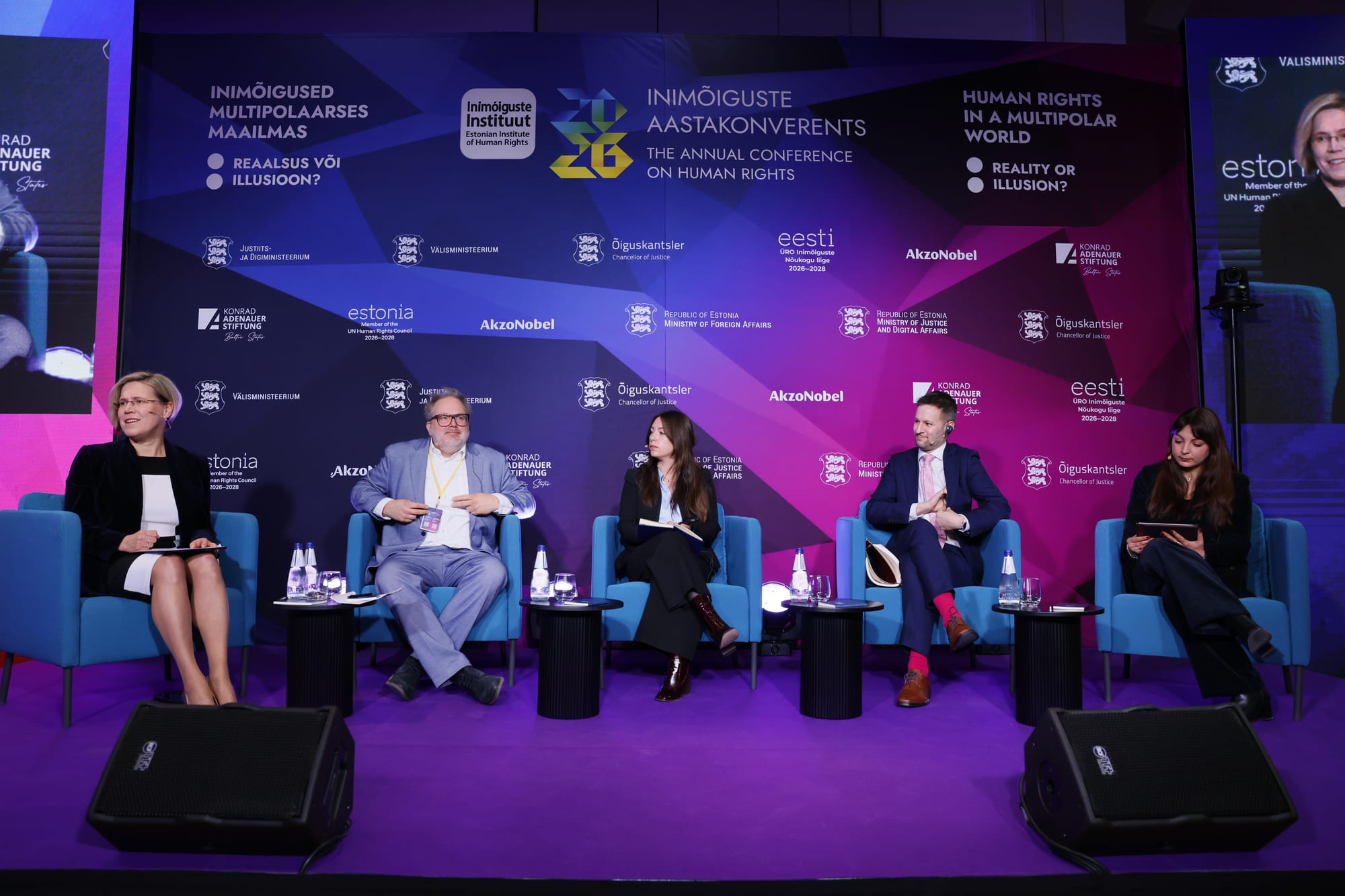
Stefania Di Stefano spoke during the panel “Techno-feudal age: who owns the digital land?”, which sought to address the question of who controls freedom of expression in an era where platforms and algorithms decide which truth becomes visible. The discussion explored the issue of human rights protection in the digital age from a variety of perspectives, including the rights to freedom of expression and thought, the protection of social and economic rights, the role of civil society and advocacy.
In her intervention, Dr. Di Stefano focused on the EU Digital Services Act, which is the latest piece of a puzzle that tries to tame big platforms’ power. She underscored that DSA is the most complete, if unperfect in some respects, legislation for imposing human rights obligations to online services. However, she also drew attention to the fact that the DSA is now under attack by some online platforms, with the support of the US government. The DSA is now being labelled as a censorship tool, with some European political groups and governments also following this narrative. She warned that this discourse is extremely problematic as it weaponises the concept of freedom of expression (and human rights more generally), and she shed light on how the idea of protecting free speech is being misappropriated to actually restrict speech and incite discrimination, hostility and violence.
She concluded by underscoring the importance for the EU Commission, with the support of EU Member states, to fully unleash the DSA’s potential, and to improve its implementation by granting more space and power to other stakeholders, particularly civil society.
The panel was chaired by Ülle Madise, Chancellor of Justice of Estonia, and participants included, aside from Dr. Di Stefano:
- Ben T. C. Warwick, a legal scholar and lecturer at Birmingham Law School,
- Nele Roekens, a lawyer and legal adviser at Unia, Belgium’s National Equality Body and National Human Rights Institution, and
- Christoph Bublitz, a legal scholar at the Faculty of Law of the University of Hamburg.